
Introduction
A Doncaster homeowner recently switched on their bathroom extractor fan after a shower, only to hear a click from the consumer unit as the bathroom lights went out. They reset the circuit and tried the fan again, but the same thing happened. When an extractor fan keeps tripping, it can be easy to dismiss it as a minor nuisance, but repeated trips are often an early warning that something is wrong with the fan or its electrical circuit.
In this guide, we look at the common reasons an extractor fan may trip the circuit, what different symptoms can tell you, which basic checks are safe to carry out, and when the problem needs to be investigated by an electrician. If the fault keeps happening, a qualified electrical professional in Doncaster can test the fan and its circuit to identify the underlying problem safely.
How to Identify Which Electrical Device Has Tripped
Open the consumer unit and look at which device has moved. An MCB, the single narrow switch protecting one circuit, trips on overload or a short circuit between live and neutral.
An RCD is the wider device that usually covers several circuits at once. It trips when current leaks to earth, which is why it takes half the house with it.
Most bathroom fans are fed from the lighting circuit, which is why the lights fail at the same moment.
Moisture is the usual reason an extractor fan trips electrics
A bathroom fan spends its life in warm, wet air. Over time, condensation finds its way into the fan casing, the terminal block or the ducting, and damp insulation lets a small amount of current run to earth.
Once that leakage reaches around 30mA, the RCD does exactly what it was designed to do. In our experience this is the single most common cause of the fault, and it is often worse in winter when the temperature difference is greatest.
Poorly routed ducting makes it worse. If the duct runs uphill into a cold loft with no fall away from the fan, water condenses in the pipe and drains back into the unit.
When the motor is the extractor fan electrical trips
Fan motors wear out quietly. Bearings dry and stiffen, the impeller becomes harder to turn, and the motor draws more current to do the same job.
That extra current shows up as heat. A motor running hot can break down internally, and the fault then presents as a trip rather than a fan that simply stops.
Dust and grease add to the problem. A build-up on the blades unbalances the impeller and loads the motor further, which is why a fan that has never been cleaned tends to fail sooner than one that has.
Cable damage that makes the extractor fan trip the circuit
Sometimes the fan is innocent. A screw driven into a joist during flooring work, a nail through a cable above a plasterboard ceiling or rodent damage in a loft will all produce the same symptom on the circuit the fan happens to sit on.
Cable connections at the fan terminal block also work loose over time, particularly where the cable has been pulled tight during installation. Where the fan is fed through a fused connection unit spurred from a socket circuit rather than from the lighting circuit, that spur carries the same limit as a single socket or a double socket taken from a ring, which is one accessory and no more, so a spur that has been extended at some point is worth checking as part of the same investigation.
This is why a fault should be traced rather than guessed at. Replacing the fan when the real problem is a damaged cable simply moves the trip a few weeks down the line.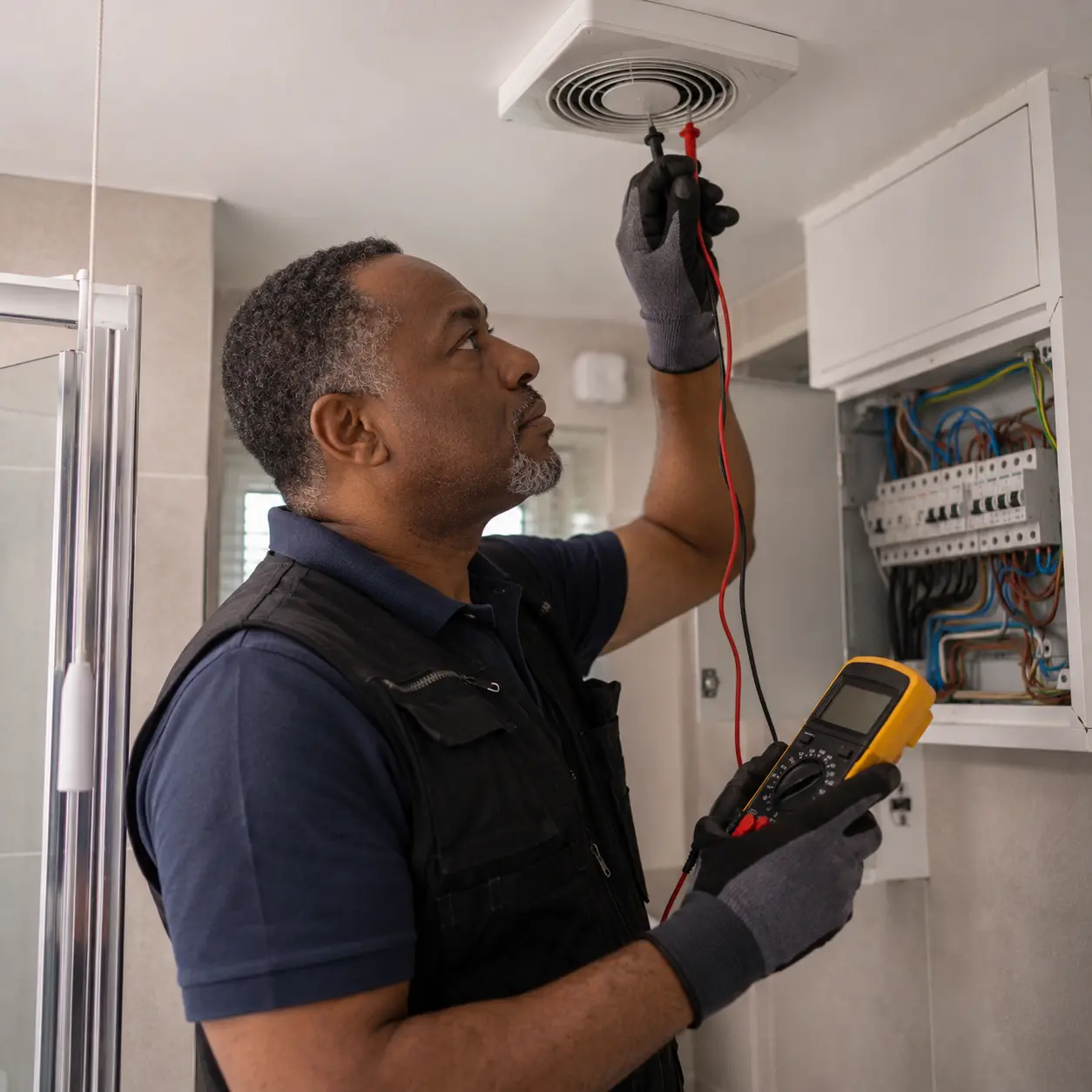
What Does the Timing of an Extractor Fan Trip Tell You?
If an extractor fan causing electrics to trip does so the instant the fan is switched on, the fault is usually a short circuit or a breakdown in the motor winding insulation that shows up under load.
If it runs for several minutes and then trips, heat is normally involved. A tired motor or a struggling impeller warms up and the fault appears once things reach temperature.
If it happens only occasionally, humidity is the likely driver. Intermittent tripping after showers, and not at other times, is a strong pointer towards moisture rather than a mechanical failure.
What you can safely check yourself
Switch the fan off at the isolator, then reset the trip. If the circuit holds, the fan or its supply is confirmed as the culprit rather than something else on the same circuit. If it trips again with the fan isolated, the fault sits elsewhere on the lighting circuit, and in a bathroom the ceiling switch is the next candidate, because of a broken pull cord light switch takes in the same moisture the fan does.
Look at the external vent outside. A blocked grille, a jammed backdraught shutter or a bird nest in the duct all make the motor work harder than it should.
Beyond that, stop. Opening a fan, testing a circuit or removing a faceplate in a room containing a bath or shower is not homeowner territory, because these are special locations under the wiring regulations with tighter requirements for enclosure protection and isolation.

How the fault is properly traced
An electrician will isolate the circuit and test the fan and cable for current leakage. They will also check continuity, polarity, RCD trip time and whether the fan has suitable protection for its position near a bath or shower.
Rose Electrical will also assess the wider installation, as combined leakage from several circuits can bring an RCD close to its trip limit, with the fan only triggering the final trip.
When Should an Extractor Fan Be Repaired or Replaced?
A loose terminal, a failed isolator or a damaged section of cable is a repair, and the existing fan can usually stay. A motor that has broken down internally, or a unit with a failed timer board, is normally replaced, and our team will size the replacement to the room rather than fitting whatever is nearest to hand.
Replacing a like-for-like fan is generally treated as maintenance work, while a new fan in a new position, or any new circuit, is notifiable building work in England when it involves a room containing a bath or shower. The requirements differ in Wales and Scotland, so the position should be confirmed locally before work begins.
Conclusion
Treat an extractor fan trip as useful information rather than something to keep resetting. The device that operated, when it tripped and whether the fan was running can help narrow down the fault. If the same circuit keeps going off, have the fan and circuit tested rather than continuing to reset it.
Rose Electrical works on domestic and commercial electrical installations across Doncaster. If an older consumer unit is contributing to repeated RCD trips, the team can also advise on upgrading the protection. If your extractor fan keeps tripping the electrics, contact Rose Electrical to have the fault properly investigated.
